Summary
Fatigue affects about 30% of GLP-1 users, and in most cases it isn't the drug itself but the sharp drop in eating it causes.
Because appetite suppression cuts calories by 16-39%, the body shifts into energy-conservation mode and misses key nutrients like iron, B12, and vitamin D.
Resting more backfires; light resistance training plus steady, nutrient-dense meals signals the body that fuel is available and usually improves energy within about two weeks.
Practical steps: don't skip meals, prioritize iron-rich foods, get vitamin D tested, add short resistance sessions, and avoid cutting carbohydrates too aggressively.
Feeling tired on a medication that's supposed to help you feels like a cruel joke
If you're on a GLP-1 medication and you're exhausted — dragging through your days, struggling to exercise, hitting afternoon walls that used to never happen — you're dealing with one of the most common and least-discussed side effects of these drugs. A cross-sectional study of GLP-1 users published in Frontiers in Nutrition found that 30% of participants reported fatigue as a side effect, making it the third most common complaint after nausea and diarrhea.
But here's what most people — and many prescribers — get wrong about GLP-1 fatigue: in most cases, it isn't the drug making you tired. It's what the drug is quietly doing to your nutrition.
The real cause: accidental under-eating
GLP-1 medications suppress appetite so effectively that most people dramatically cut their caloric intake — often without realising how much. A 2025 joint advisory from the American College of Lifestyle Medicine, American Society for Nutrition, and the Obesity Medicine Association reported that GLP-1 users experience caloric reductions of 16–39%. At those levels, the body enters an energy conservation mode: it slows output to match reduced input. The result is the fatigue you're feeling.
The nutrient depletion layer
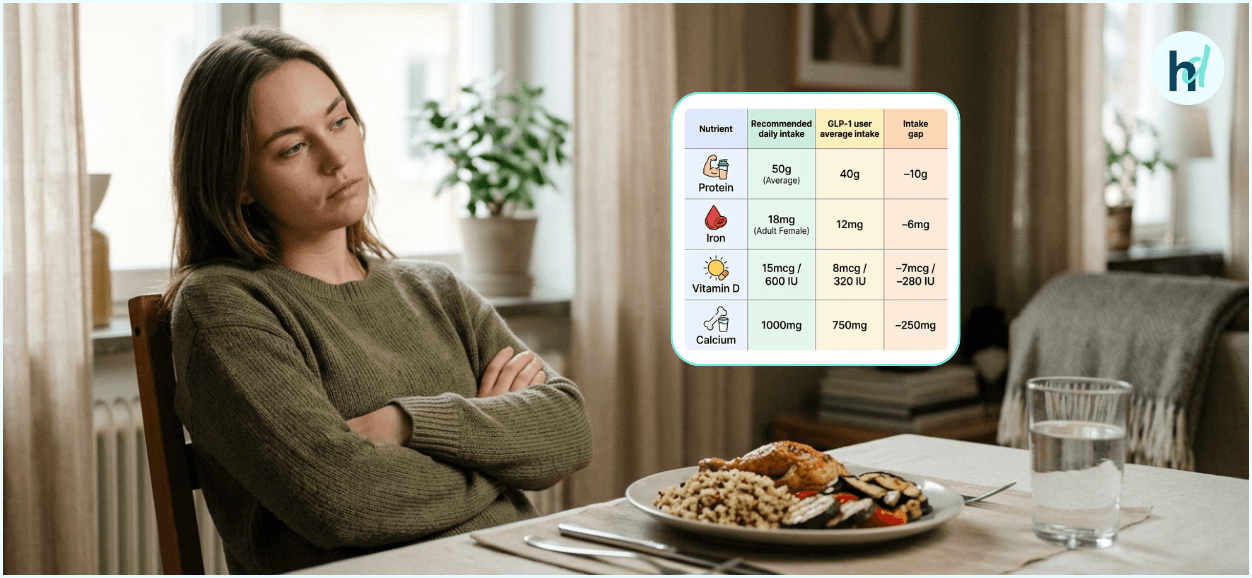
Under-eating on GLP-1s doesn't just reduce calories — it reduces the vitamins and minerals your body needs to produce energy. A 2026 narrative review covering nearly half a million GLP-1 users found that over 60% consumed below estimated requirements for iron and calcium, vitamin D deficiency was present in 7.5% at six months and 13.6% at twelve months, and protein and calcium insufficiency directly contributed to lean mass loss. Iron, B12, and vitamin D are all directly involved in energy production at the cellular level. When any of them drop, fatigue follows.
Why 'rest more' is the wrong answer
The instinct when tired is to rest more and reduce activity. For GLP-1-induced fatigue, this is counterproductive. Light resistance training and structured movement actually signal the body that resources are available, which reverses the conservation response. Combined with strategic nutritional re-loading, most people we work with see a meaningful improvement in energy within two weeks.
What actually helps
Don't skip meals — even when you're not hungry. Small, scheduled, nutrient-dense meals keep energy stable and prevent the depletion spiral.
Prioritise iron-rich foods — lean red meat, lentils, spinach. If you're female, get ferritin checked at your next blood test.
Get vitamin D levels tested — deficiency is extremely common in GLP-1 users and directly causes fatigue, low mood, and muscle weakness.
Add light resistance training — even 20-minute sessions twice a week counteract the metabolic conservation response.
Avoid cutting carbohydrates too aggressively — glucose is the brain's primary fuel. Eliminating carbs while on a GLP-1 compounds energy depletion.